
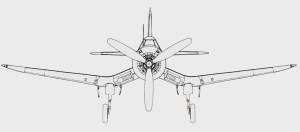
There were a several WWII pilots who flew the online flight simulators Air Warrior and Aces High, but Earl seemed to stand out and willing to share his experiences.
The connection history of Earl “Dutch” Miller and the online multiplayer flight sim Air Warrior and it’s Bigweek server(s) are nostalgic, but none as sensational as Earl’s life and experience. He shared his stories and knowledge with us aviation and flight simulator enthusiast of the online flight sim Air Warrior, on an NNTP server called Bigweek.general.
Earl’s journey to becoming an Air Warrior pilot involved meeting players who introduced him to the simulator, which he enjoyed.
When he posted to the newsgroup, he captivated an audience of star-struck enthusiasts, including players, game creators and staff, eager to learn directly from a heroic World War II pilot.
Below the story of Earl Miller and our connection with him.
Kesmai was a pioneering game developer and online game publisher, founded in 1981 by Kelton Flinn and John Taylor. The company was best known for the combat flight sim Air Warrior on the GEnie online service, one of the first graphical MMOGs, launched in 1987.
Air Warrior – the grandfather of the WWII multiplayer games – had a BBS (bulletin board system), similar to the one for Aces High by HiTech Creations, the game all had wished Air Warrior would have evolved into prior to its sad demise. Many of us from Air Warrior soon called Aces High home.
Around 1997, the Air Warrior Gods attempted a large multi-player mission, inspired by the WWII Big Week missions of February 20-25, 1944. A goal was for up to 10,000 virtual pilots in one arena. They created a separate BBS for participants to discuss and reflect on the experiment.
The Big Week missions worked, the Bigweek BBS was a huge hit, and people made lots of virtual friends.
Kesmai abandoned Bigweek.general after about couple months and Frenchy (Fnchy) setup an NNTP server (Network News Transfer Protocol) and kept Bigweek.general alive. A huge number of subscribers including old DOS Air Warrior folks, even HiTech himself, among many others posted there. TK (DJ Nephew) took over the servers in about late 1998.
In 2000, Trip from England took over the old server as TK no longer wanted to maintain it. In 2002, EA acquired Kesmai and discontinued Air Warrior, leading to dwindling interest in Bigweek. After the Air Warrior closure some occasionally checked in until 2014, when a few users were still posting.
Earl “Dutch” Miller
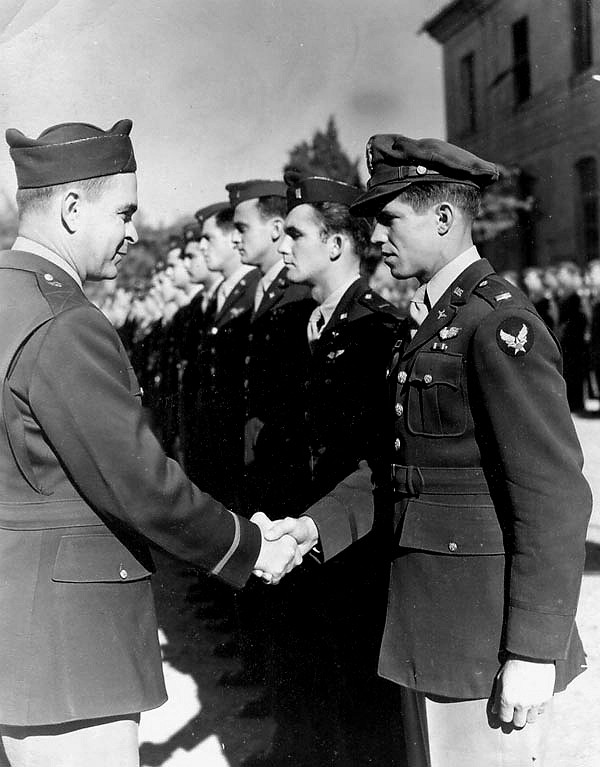
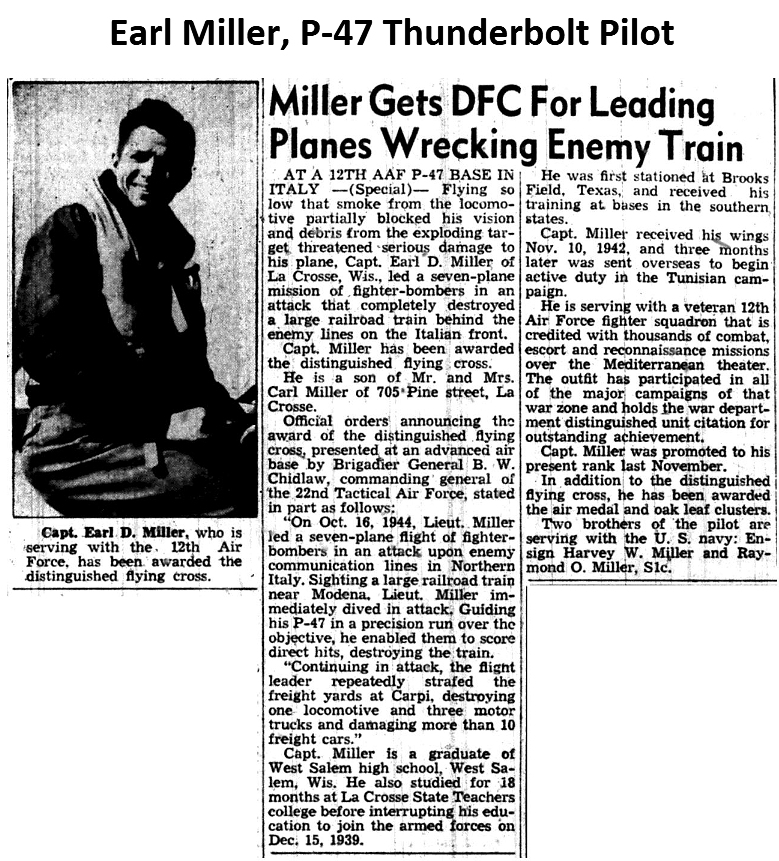
La Crosse Tribune, 1945 March 11, page 5
Earl “Dutch” Miller was born in October 1918 on a farm near Barre Mills. As the oldest of seven children, he worked on his family’s farm and also for other area farmers. Miller had a part-time job setting pins in a La Crosse bowling alley too. He graduated from West Salem High School in 1936.
Miller enrolled at the La Crosse State Normal School (now the University of Wisconsin-La Crosse), but his academic pursuits were derailed by an episode of scarlet fever.
He enlisted in the Army in mid-December 1939. Miller became a mechanic in the Army Air Corps in Texas. Following a 13-month posting to Puerto Rico, he came back to the United States for pilot training.
After earning his pilot’s wings, Miller went overseas in February 1943 to North Africa.
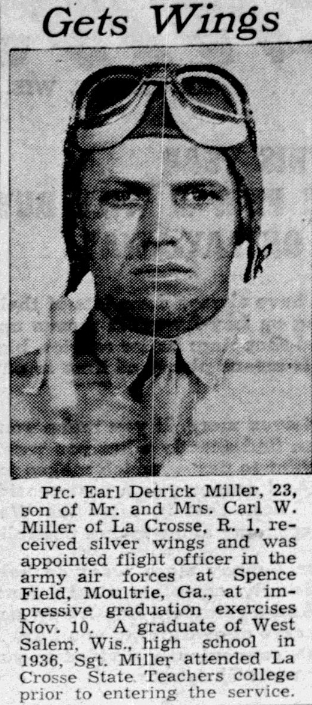
Miller flew fighter aircraft in support of American ground troops as they advanced through the Mediterranean Theater. First, he was in Tunisia and then part of the invasion of the island of Sicily. As the battlefront moved to Italy, Miller’s unit followed providing air support. In less than eight months in 1944, Miller was promoted to second lieutenant, first lieutenant, and captain. He was a member of the 350th Fighter Group.
Captain Earl Miller primarily flew the Republic P-47 Thunderbolt (“Jug”). It was just over 36 feet long and had a wingspan of almost 41 feet. The Thunderbolt had the distinction of being the heaviest one-seat, propeller-driven fighter plane ever built by the United States. When loaded, it weighed 14,500 pounds.
Several models of the P-47 were built for the Army Air Corps, with the delivery of the P-47B in March 1942 being the first, that improved capabilities in each successive version. Depending on the version, the single engine put out 2,000 to 2,800 horsepower for a maximum speed of 430 miles per hour. It boasted eight .50-caliber machine guns on its wings. Some versions could carry a bomb load of 2,500 pounds. The P-47N mounted three 500-pound bombs and ten rockets. This armament made it a fearsome ground-attack aircraft. It had a range with a heavy bomb load of 475 miles, but with three drop tanks it could stay in the air for nine hours and fly 1,150 miles.
More P-47 Thunderbolts were produced, 15,660, than any other fighter plane in American history.
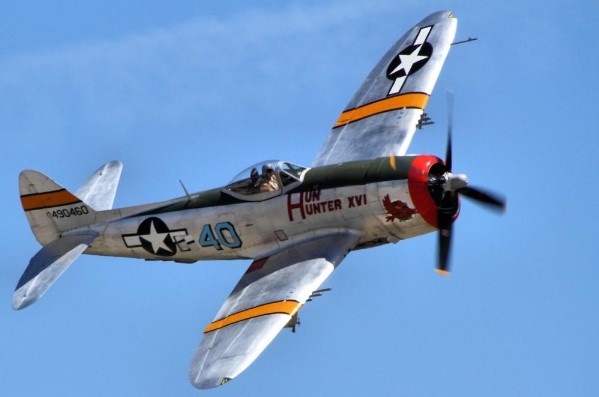
(The National Interest)
P-47Cs were introduced to the European Theater in January 1943 to escort heavy bombers and fly fighter patrols over the continent. But the P-47C did not have sufficient range to escort bombers all the way to their targets and back.
The P-47D, which introduced the bubble canopy for better visibility, accounted for seventy-five percent of all Thunderbolts produced. It was a rugged aircraft with a lot of firepower and range.
In two years and one month of combat in the European Theater, Thunderbolts destroyed 6,300 enemy aircraft at the cost of 3,500 of their own. Thunderbolts also served in the Pacific Theater.
Thunderbolts operated mostly as fighter-bombers with the 15th Air Force in Italy. Flying from a base about 30 miles behind the lines of the 5th Army, groups of four to eight Thunderbolts strafed and dive-bombed German troops and vehicles, as well as railroad bridges and trains. Low-level missions exposed the planes to ground fire, and Miller’s aircraft was hit several times. He even had to make a belly landing once because of damage to his aircraft.
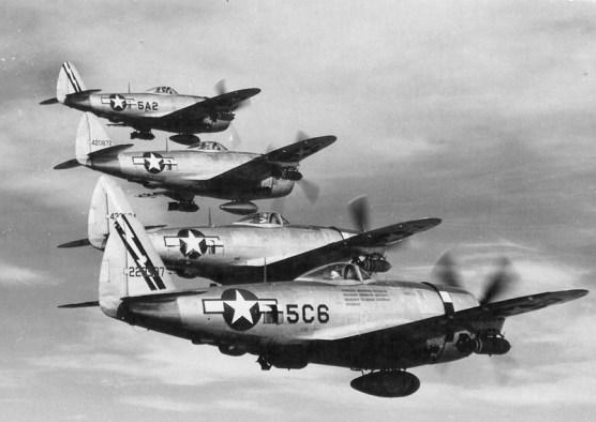
(MilitaryHistoryNow.com)
Earl Miller flew 186 combat missions and earned the Silver Star, two Distinguished Flying Crosses, and several air medals.
Captains and Majors during the war who remained in the Army Air Corps after World War II reverted to First Lieutenants in the Regular Army after the war. Less than a year after World War II ended, Miller started his training as a jet fighter pilot, in the P-80 Shooting Star, at Williams Field in Arizona as a member of the 362nd fighter group. Miller was a member of the 20th fighter group at Shaw Field in South Carolina.
When one of his buddies from the war went to Texas to visit his girlfriend, Miller tagged along. There he met one of the sisters of the girlfriend. Ruth “Gerry” Bagley and Earl Miller were married in 1947.
Here are just a few of his assignments during his postwar career. In 1951, Major Miller was stationed at Tyndall Field in Florida. His next assignment was supervisor of pilot training at the Instrument Pilot School at Moody Air Force Base in Georgia starting late in 1952. In early 1956, Miller became an operations officer for the newly-formed 19th Air Force at Foster Air Force Base in Texas.
Miller flew 109 more combat fighter missions in the Korean War and the Vietnam War.
Lt. Colonel Earl Miller retired from the Air Force in 1969.
He and his wife bought a hobby farm at La Crescent, Minnesota. Miller was the commander of the La Crescent American Legion post, the Veterans of Foreign Wars post in Brownsville, and the La Crosse chapter of the Retired Officers Association. He flew Cessna planes from the La Crosse Airport until he was in his late 80’s.
After his wife died in 2007, Miller moved to Eagle Crest in Onalaska. He died in April 2014 at the age of 95.
After a 30-year military career and service in three wars, we can say with certainty that Earl “Dutch” Miller was truly a hero living next door.
Jeff Rand
Adult Services Librarian
La Crosse Public Library
A Portion of Earl’s personal flight logs
Earl had transcribed some of his flight logs and shared them with us on Bigweek newsgroup.
May 23, 1942:
I had a solo flight in a Stearman PT-17 for 1:05 hours.
May 25, 1942:
I flew a dual flight in a Stearman PT-17 for 53 minutes.
May 27, 1942:
I flew a dual flight for 43 minutes in a Stearman PT-17.
May 28
June 1, 1942:
At the Mississippi Institute of Aeronautics, near Jackson,
Mississippi, I flew
55 minutes dual and 48 minutes solo in a Stearman PT-17.
June 2, 1942:
I flew 54 minutes of dual instruction and 1:06 hours of solo
time in a Stearman PT-17.
June 3, 1942:
I flew 1:03 hours of dual instruction and 1:58 hours of
solo time in a Stearman PT-17.
June 4, 1942:
I flew 1:23 hours of solo flight in a Stearman PT-17.
June 5, 1942:
I had 1:10 hours of dual instruction in a Stearman PT-17.
1943:
At Maison Blanche airport, near Algiers, North Africa, I
flew a P-38G for 40
minutes and practiced ground gunnery in a P-39N for one
hour.
1943:
I practiced ground gunnery for 40 minutes in a P-39N.
1943:
I flew a P-39N for one hour of slow time.
1st Lt. Vincent J. Dugan, 347th Fighter Squadron, 350th
Fighter Group was killed after taking off from Maison
Blanche airfield, Algiers in bad weather with a load of
“supplies” for a squadron party planned at his home field,
Taher airfield, 125 miles east. His P-39 struck a hillside
20 miles east of Algiers while he was trying to fly under
low clouds. Don’t know what happened to the “supplies”.
1943:
I had my first flight in a P-38. I flew a P-38G for 1:00
hour. I also flew a P-39N for 10 minutes.
May 24, 1943:
I flew a P-39N for one hour of slow time.
F/O Hugh E. McCall, 347th Fighter Squadron, 350th Fighter
Group was a member of a P-39 flight sent out from Taher
airfield, Algeria to search for an enemy pilot who was shot
down at sea. The pilot was found and picked up by a Walrus.
1943:
I flew a maintenance test flight for 30 minutes in a P-39N.
I flew a P-38G for 1:30 hours in the Algiers area.
May 31, 1943:
1st Lt. Joseph L. Morsheimer, 347th Fighter Squadron, 350th
Fighter Group was scrambled to intercept a Ju-88 recce
aircraft. He sighted the enemy aircraft overhead, but at
16,000 feet his P-39 blew an engine cylinder. He undershot
the Taher airfield by 100 feet when making a “dead-stick”
landing. The aircraft stopped with its nose in the sand.
2nd Lt. John B. Byrn, 347th Fighter Squadron, 350th Fighter
Group was flying the squadron’s L-4 Taylorcraft aircraft,
which was acquired when it was left by some Army unit and
repaired and flown by the pilots, nosed up in a shallow
ditch on the airfield. The propellor and engine exhaust
were damaged, but Byrn was all right.
1943:
I flew 1:55 hours in a P-39N.
Each squadron of the 350th Fighter Group was assigned two
P-38s for the interception of high altitude enemy
reconnaissance aircraft.
Sometime in late May or early June (I have no specific date)
F/O Kenneth B. Smith, 346th Fighter Squadron, 350th Fighter
Group was returning from a convoy patrol mission in a P-39
when he saw a submarine 20 miles east of Algiers. He flew
low over it and could see no markings. He checked with the
Controller, who had no information, but advised, “Use your
own discretion”. Smith attacked the submarine with both his
cannon and machine guns and reported that he got some hits
on it. Later, the squadron learned that a British submarine
had filed a formal complaint. The squadron kept “mum”
1943:
I flew a P-39N for 1:30 hours.
June 13, 1943:
Six P-39s from the 346th Fighter Squadron flying out of
Tunisia on a sweep near the Pantelleria Island tangled with
a bunch of Fw-190s. I will need to sort out the action and
write it up in a suitable sequence, but don’t have the time
to do it now. Look for it later
1943:
I was scrambled in a P-38G for a 40-minute flight in the
Algiers area. No joy.
1944:
I ferried the Hurricane from Alghero to Elmas airfield at
Cagliari, refueled and flew to Palermo, Sicily. The
British commander there asked me if he could borrow the
Hurricane to take their Flight Surgeon up for a spin. I
said, “Sure”, and went off to find chow and sleeping
quarters for the night.
1944:
My flight ferried the P-39Qs from Naples to Alghero,
Sardinia, a 1:45-hour flight.
1st Lt. Harry R. Carney, 345th Fighter Squadron, 350th
Fighter Group, had engine failure of his P-39 while on
convoy patrol over the Strait of Bonifacio. He bailed out
10 miles northwest of Maddalena and landed on the beach on
the south side of the strait. He rode a horse for 20 miles
to a small airfield at Albio, where he was picked up by
Major Lee C. Wells, the Squadron Operations Officer, in the
two-place Hurricane.
1944:
I took my flight to Monte Cavino, Italy to pick up
P-39Qs. We flew them to Naples, a 30-minute flight, to be
checked by our mechanics before ferrying them to Sardinia.
1944:
I flew a maintenance test flight in a P-39N for 30
minutes.
1944:
At Alghero Airfield, Sardinia, I was preparing to ferry our
Hurricane to Naples, Italy.
In late May or early June (I don’t have a specific date) 2nd
Lt. Clifford L. Stockwell, 347th Fighter Squadron, 350th
Fighter Group, based at Aghione airfield, Corsica was
scrambled with wingman 2nd Lt. Maurice A. Brasch. They
climbed up through the overcast, but made no contact with
the bandit. Upon landing, Stockwell was asked if he had
seen any flak. Upon review, it was discovered that the
Ajaccio AAA had fired at aircraft in the clouds for several
minutes.
1944:
I flew the Hurricane from Palermo to Naples in 1:30 hours,
just about max range. When I came down to the flight line
that morning at Palermo, the British commander was waiting
for me. He thanked me for the use of the two-seated
Hurricane and offered to trade a Spitfire for it. I told
him I had no authority to do that, but I would relay the
offer to my commander. After arriving at Naples, I
mentioned the offer to the Squadron Commander. He asked,
“Why didn’t you trade?” I told him I would be glad to fly
back to Palermo. End of story!
June 9, 1944:
A 347th pilot flying CAP over minesweepers off the coast of
Italy near the front lines had engine trouble with his P-47
and had to return to Corsica, 90 mile away over the Med.
A 346th pilot was scrambled in a P-39 with the control
locks still on. He had to use trim tabs to climb up high
enough to remove them. Removing them required some forward
stick movement.
June 10, 1944:
2nd Lt. James K. Levy, 347th Fighter Squadron, 350th
Fighter Group, in a P-39, was on reconnaissance flight to
Elba Island to locate harbor defenses at Port Ferraio for
a planned Allied (French) invasion. While crossing the bay
at high speed on the deck, he crashed within 200 yards of
the shore, probably due to AAA. KIA.
The 346th Fighter Squadron was transferring from Tunisia to
Sardinia. One of the pilots made a departing buzz job near
dusk and hit an elevated roadway at high speed. The P-39
disintegrated and the pilot was sent to the US and, after
spending five months in a coma, recovered.
1944:
I flew a P-39Q for 15 minutes. I assume it was a
maintenance test flight.
1945:
I flew 3:15 hours in the AT-6.
1945:
I flew an AT-6 for 1:10 hours at the Central Instructors
School, Single Engine Advanced at Waco, Texas,
1945:
I flew 2:30 hours in an AT-6.
June 11, 1945:
I received orders to report to Chanute Field to attend the
Officers Engineering Course. I had applied for the course
as soon as I arrived at Waco. The irony is that I was
scheduled to check out in the single P-40 on the base the
very day that the notice arrived.
1945:
I flew 2:40 hours in an AT-6.
2nd Lt. Billy B. Ashbaugh of the 345th Fighter Squadron,
350th Fighter Group crashed at sea and was killed while on
a post-war training flight in a P-47 off Leghorn, Italy.
He flew too low, allowing the propeller to touch the sea
and was unable to get the nose back up because the water
spray made his elevator ineffective. In 1952 that P-47 was
snagged by a trawler and raised to the surface . Ashbaugh’s
remains were recovered and buried in Arlington National
Cemetery. He was the 350th Fighter Group’s last casualty.
1946:
The four of us flew our P-51s back to Biggs Field from the
air show at Tarrant. Flight time was 2:15 hours. Upon
returning to Biggs, I was told we would soon be going to
Myrtle Beach, South Carolina, for gunnery practice.
1946:
Based at Biggs Field, El Paso, Texas, four of us flew P-51s
from an RON at Waco,
where we were weathered in enroute to Tarant, Texas, for an
air show. Flight time
was 40 minutes.
1946:
Four of us, flying P-51Ds, were enroute from Biggs Field,
El Paso, Texas to Tarrant to perform in an air show, when
bad weather forced us to RON at Waco Field.
1946:
The four of us flew 1:15 hours at the Tarrant Air Show. We
had missed one day because of our RON at Waco. We had one
aircraft on static display for the day and took turns
answering visitors’ questions until we were scheduled to
fly. The P-51 was considered a modern fighter at that time
and sparked a lot of interest among the local folk. When it
was our turn to fly, we took off in twos, joined up over the field and
climbed out some distance waiting our turn, at which time
we made a low-level, high-speed pass over the field. We
didn’t perform aerobatics.
1946:
I picked up a left magneto and some tools at squadron
supply and flew a P-51 to the airport at Huntsville,
Alabama. The disabled P-51 was parked in front of the
operations building. As soon as I began removing the side
panels, a fellow who said he was an aircraft mechanic, came
out asking me what I was doing. When I told him, he asked
to see my Aircraft Mechanic Certificate. When I was unable
to produce one, he ordered me to stop work and replace the
panels. When I refused, he left and soon returned with the
airport manager who, after I explained my situation, let me
continue. All through the procedure, the mechanic would
come over occasionally to watch me. As I removed the
magneto from the housing, he said, “Now you’ve done it!”
and left. He didn’t bother me any more the rest of the
time. When I had replaced the magneto, I ran a magneto
check. They checked out OK. Since it was getting late,
I asked the pilot if he would replace the side panels.
As I taxied past the operations building when leaving, I
saw the mechanic standing in the window. I gave him a
hearty thumbs up.
1964:
I had a 2-hour orientation flight at the Navy air Base at
Corpus Christi in a T-28. The flight included 8 landings.
June 12, 1964:
I was given a check ride of 1.3 hours (Naval decimal system)
in a T-28. The Navy was very cautious about Air Force
pilots, I guess. This flight included 7 landings.
1965:
At Pleiku, South Vietnam, I was attending to my duties as
Chief of the Air Force
Advisory Team (AFAT) and advisor to a Vietnamese Air Force
(VNAF) wing.
1965:
I went to Nha Trang in a U-17 to fly dive-bombing missions
in the A-1H.
2002:
I departed for the 345th Fighter Squadron reunion held in
Milwaukee, Wisconsin. I expect to return on Monday.
Earl “Dutch” Miller
Obituary
ONALASKA — Earl “Dutch” Miller, 95, died April 9, 2014, at Eagle Crest Bethany Lutheran Home, Onalaska, after having lived a long and productive life.
He was born Oct. 28, 1918, to Carl and Charlotte (Lumley) Miller, a farming family in Barre Mills, and he was the eldest of seven children. He grew up in the Depression farming for his family, for other farmers in the area and literally running to La Crosse to set pins at a bowling alley. He graduated from West Salem High School in 1936, and briefly attended La Crosse Normal School, cut short by a bout with scarlet fever. He enlisted in the Army in 1939, and entered the Army Air Corps where he underwent flight training. He was a pilot as World War II began for the United States, and he was sent for war duties to North Africa and eventually Italy. He flew fighter planes, including the P-39 Airacobra, the P-47 Thunderbolt, and the P-51 Mustang and he flew 186 combat missions overall. During this time he was commissioned from flight officer to lieutenant and ended his war duties as a captain. For his distinguished war service he was awarded the Silver Star, two Distinguished Flying Crosses, and multiple air medals.
After the war, he accompanied a war buddy to west Texas, to visit his buddy’s girlfriend, who also had a few lovely sisters. It was there that he met his future wife, Ruth “Gerry” Bagley. He and Gerry were married in 1947, and she may have been unaware at the time of what a life in the military would mean for her. Almost annually, they traveled to multiple assignments in the U.S., mostly in the southeast where fighter units were located and along the way they had their first born, Barry, in Riverside, Calif., daughter, Karen in San Angelo, Texas, and next daughter, Carla in Victoria, Texas. Besides his World War II experiences, he also flew combat fighters in Korea and Vietnam (109 combat missions). After 30 years of service, he retired in 1969 from the Air Force as a lieutenant colonel, and he, Gerry, and Carla moved to Minnesota; Barry and Karen had already left their nest. They settled into a “hobby” farm on South Ridge in La Crescent, where he bought three tractors to till 40 acres of sweet corn. During that time he was president or commander of the American Legion post in La Crescent, the VFW post in Brownsville, and the Retired Officers Association chapter in La Crosse. He also was a volunteer fire marshal for Houston County. Ever the pilot, he continued to fly small Cessnas out of the La Crosse airport until his late 80s, worrying any non-pilots (or their spouses) who went up with him. He and Gerry sold their farm in 2006, and moved to La Crosse, where Gerry died in 2007. After her death, he moved to Eagle Crest, a Bethany Lutheran senior facility in Onalaska, where he thoroughly enjoyed his last years. It wasn’t long after getting there that he convinced their residents that there should be more Happy Hour meetings than just the one on Friday, so, under his influence, Happy Hour eventually expanded to every week day afternoon. He also printed and published the dining menu for the coming week, distributing it to residents.
Videos
To see Thunderbolts in action:
How to Fly the P-47, Part 1 (1943 documentary)
How to Fly the P-47, Part 2 (1943 documentary)
362nd Fighter Group Over Germany
Restored Republic P-47 Thunderbolt flight demo
P-47 Thunderbolts at 2014 air show
END
 Aces High Tech Hangar